Wirevolution

Mobile Unified Communications

Subscribe!

Archive for the ‘FMC’ Category

Femtocells, FMC, Wi-Fi

Wednesday, July 25th, 2007

There’s an interesting article on femtocells in EETimes. It mentions the Femto Forum. It is a thoughtful look at the prospects for femtocells, a welcome counterbalance to the hype. The most telling quote is from the CTO of Ubiquisys:

We—that is, the femtocell ecosystem—probably have a two-year window to make our mark, ensure we come up with standard interfaces, and, above all, avoid fragmentation.

The two year comment is about beating Wi-Fi dual mode phones to the punch. But currently the primary driver for Wi-Fi in cell phones is feature inflation in high-end handsets, not FMC. In other words, there are really two dynamics driving Wi-Fi into handsets, FMC is the minor one and feature inflation is the major one; femtocells don’t affect the latter.

So if femtocells overcome their numerous challenges, FMC services for consumers will come mainly through femtocells. Femtocells will not impact Wi-Fi attach rate much, since Wi-Fi is becoming a checklist feature on high end phones. How useful the Wi-Fi in these handsets will be depends on how successful the phone makers are at keeping them open.

New York Times tells it like it is

Thursday, July 5th, 2007

David Pogue, the gadget-maven at the New York Times, went to a cell phone conference in Italy last week, and learned a few home truths.

On Independence Day he wrote a column that lambasted the US cellular carriers for their conservatism, and the following day he eulogized T-Mobile for deploying UMA. The UMA writeup is a PR flack’s dream. All true, too.

In the column on the calcification of the US cellular carriers, he indulged in a bit of wishful thinking:

If the iPhone becomes a hit, then, it could wind up loosening the carriers’ stranglehold on innovation.

Seasoned denizens of this industry may scoff, but it must be possible. And while UMA strives to exploit the VoIP genie while still keeping it in the bottle, at least its another step in the right direction. In the column on UMA, Pogue made a prediction that I happen to agree with:

But hard to believe though it may be, T-Mobile did make an announcement last week. And even harder to believe, its new product may be as game-changing as Apple’s.

The Wall Street Journal has already made the observation that the network operators don’t necessarily have their subscribers best interests at heart. But these two events in the same week may mark some kind of a turning point. I hope they do.

T-Mobile launches FMC nationally in USA

Wednesday, June 27th, 2007

***Update: I went to the T-Mobile store this morning and signed up. The service here in Dallas is $10 per month, not $20 as reported by Reuters. The store manager also told me that people with poor cellular reception at home can use the UMA service at no additional monthly charge, but that this usage is treated the same way as cellular usage – in other words, it counts against your cellular minutes.***

***Update 2: Here are some details on the T-Mobile launch campaign. ***

Reuters reported this morning that T-Mobile is rolling out FMC service nationally.

Subscribers would pay an extra fee of up to $19.99 per line or $29.99 for five lines on top of regular monthly cellular bills for unlimited calls in a subscriber’s home or the nearly 8,500 places T-Mobile runs Wi-Fi, like Starbucks coffee shops.

This pricing model seems ambitious, compared to what it is competing with. T-Mobile’s MyFaves 300 plan gives you unlimited minutes nights and weekends and unlimited minutes to a list of five people that you choose. So the 300 minutes are consumed during the day, calling to people whom you call infrequently. For $20 more you can bump this to 1,000 minutes. Alternatively, you can spend that $20 on the FMC service. It seems like the FMC service would only be a better deal for people who are home all day (or at Starbucks), who want to talk a lot to people beyond their five most frequently called. MyFaves 1000 would be a better deal for people who want to talk to a large variety of people during the day when they are not at home, for example in the car or out of range of a Starbucks – like at work, for example.

So who are these people that this “HotSpot@Home” service is aimed at? Surely there can’t be many. Why doesn’t T-Mobile use this technology to gain more customers, by giving it away free to subscribers? This would appeal to all the people who have poor reception at home, who would feel bilked by having to pay extra just for acceptable quality of service there (Hey! They do! See the update above). Another way to increase customer appeal would be to go with a wideband codec for Wi-Fi calls, guaranteeing CD-quality sound to Wi-Fi on-network calls. Or why not do both? This would provide a viral motivation to complement MyFaves, it would be unique among US carriers, it would improve retention, and it would bring new subscribers to start exploiting all that spectrum that T-Mobile picked up in the AWS auction in September 2006.

Dual mode phones taking off?

Tuesday, June 5th, 2007

Instat came out yesterday with a report entitled “Portable Connectivity Driving Wi-Fi Chipset Market.”
The report says:

Although dual-mode cellular/Wi-Fi handsets represented only 3% of total shipments in 2006, this category will be the breakout market segment in 2007, and will reach 20% of the total Wi-Fi chipset market in 2009.

A look at the database of smartphones and PDAs at pdadb.net reveals that of 343 phones listed, 192 have Wi-Fi; of the 96 phones released since December 2006, 76 have Wi-Fi. This confirms Instat’s opinion at the top end of the phone market.

Although the smartphone market is small relative to the overall cell phone market (4% in US, 9% in Europe according to Telephia), it is still big. With well over a billion cell phones being sold in 2007, the number of smartphones will be of the order of 100 million. In another report, Instat predicts about 400 million Wi-Fi chipsets to be sold in 2009. So the 20% number seems quite doable with smart phones alone.

If FMC takes off, Wi-Fi will also become common in non-smartphones, and the volume of Wi-Fi chip sales will be even higher. But mobile network operators remain tentative about FMC; rapid widespread rollout is not happening yet. Consumers rightly see little value in FMC the way that it is currently being sold to them. FMC is more likely to be led by enterprises deploying smart phones using third party applications to extend their PBX. The mobile and fixed operators have the power to thwart this use of their networks, and some will. But the benefits of this model to enterprises are clear and compelling, so it will eventually prevail.

Reuters says FMC “years off”

Wednesday, May 23rd, 2007

Reuters ran a story today from the FMC World Congress in Amsterdam.
The article cites very weak consumer uptake leading to the cancellation of T-Mobile’s T-One service in Germany, and weak uptake also at Neuf Cegetel. It seems strangely unbalanced, since it doesn’t mention T-Mobile’s imminent national rollout of FMC in the USA, the BT/Vodafone Fusion service and the FT/Orange Unik service. There are several other UMA deployments that would have made the outlook seem less gloomy.
The T-Mobile service was survived in Germany by T-Com’s similar service, Telekom-Vorteil, a “fixed/Wi-Fi” service that routes wireline calls over Wi-Fi, so you can use a Wi-Fi phone or the Wi-Fi of your dual mode phone to pick up calls on your home number when you are at home. This is not UMA based, and drops the call when you move out of Wi-Fi range. People like it.

Dual mode phone trends

Monday, May 14th, 2007

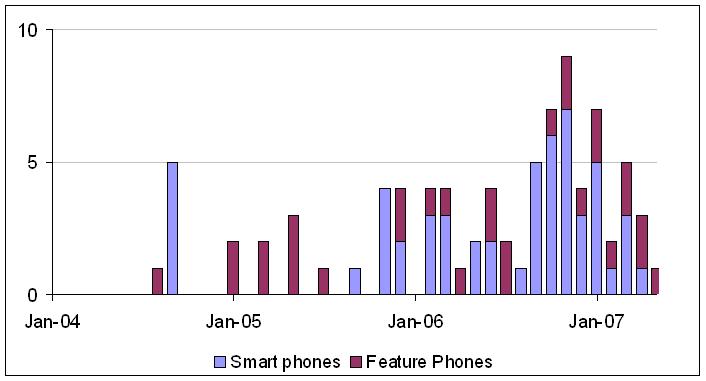
Here is a chart of the number of dual mode phones certified for Wi-Fi each month starting in 2004, compiled from data found on the Wi-Fi Alliance website. There is a suggestion of a trend over the first few months of 2007, but of course it’s too early to call the entry of FMC into the trough of disillusionment. In the first three months of 2007 there were 14 certifications, versus 8 in the first three months of 2006. That’s a healthy 75% year on year increase. When you look at it on a quarterly scale, the first calendar quarter of 2007 is the second best ever, beaten only by the twenty certifications in the fourth quarter of 2006. But broken down by month it looks like certifications are sliding. There has only been one so far in May.
Wi-Fi certifcations of dual mode phones

WSJ on FMC

Thursday, May 3rd, 2007

Today’s Wall Street Journal has a good article about T-Mobile’s UMA trial in Seattle. It says that T-Mobile may be rolling it out nationally as early as next month, despite some trial particpants’ complaints about handoff and battery life issues. T-Mobile will be offering a home router to help with QoS and battery life. I presume that for the battery life this is just WMM Power Save (802.11e APSD) since that is what the phones in the trial (Samsung T709 and Nokia 6136) support. For QoS side I expect these APs will support WMM (802.11e EDCF), but they could also support some proprietary QoS on the WAN access link, the way that the AT&T CallVantage routers do, which would be interesting.

There is some background on the trial here.

The article goes on to put the trial into the context of other FMC deployments, from BT Fusion, Telecom Italia and Orange. The article quotes a Verizon Wireless spokesman saying that they aren’t convinced that Wi-Fi can deliver high enough voice quality to carry Verizon branded calls. This is amusing bearing in mind the usual quality of a cellular call in a residence.

The article also quotes Frank Hanzlik, the head of the Wi-Fi Alliance as saying that business FMC may have more potential than consumer. I agree.

In-Stat report on FMC shows slow uptake

Monday, April 2nd, 2007

In-Stat recently published a report on FMC. It shows most people still relatively uninterested in running voice on increasingly pervasive Wi-Fi networks, though PBX users are intrigued by the potential of dual-mode phones.

DiVitas and enterprise-controlled FMC

Wednesday, March 7th, 2007

Still at VoiceCon, there was a great presentation in a FMC panel by Vivek Khuller of DiVitas Networks. DiVitas has just released a product that rebuts the idea that cellular/Wi-Fi roaming requires participation by a Mobile Network Operator. Cellular companies get the vast bulk of their revenues from consumers, (though business users are more profitable) and have not been motivated to tailor their services to businesses. This offering from DiVitas, and MVNO efforts like Sotto address a gaping need in the market.

Vivek prefaced his presentation by enumerating three big-picture observations.

First, the current crop of FMC devices is actually the second generation – we just didn’t recognize the first generation, which is mobile computers. They are converged devices because they have multiple network connections: POTS (built-in modem), Ethernet, Wi-Fi and possibly a WWAN card from Verizon or Sprint or whoever. Of course the truth of this observation depends on your definition of FMC, but it illuminates the roots of DiVitas’s strategy.

Second, when you start a job at a new company, they give you two things, a phone and a computer. They get both of them through the same type of channel, which is not a service provider.

Third, Skype came out of the blue from the service provider perspective; none of their founders had any voice service provider experience, but Skype is now the biggest voice service provider in the world in subscriber count.

He then launched into his presentation, pointing out that cellular penetration in the consumer space is about 75%, while in the enterprise space it’s only 20%, even though 75% of workers consider mobility “critical” or “important,” and the chances of finding a person at their desk are less than 30%.

He gave the reasons for the lack of penetration of cell phones in the enterprise as cost, control and complexity. On the cost front, he showed us his corporate phone bills – $14K for mobile and $1.4K for wireline. He acknowledged that a lot of his cellular use was lab testing, but felt that the point was still valid – cellular service is actually roughly 10x as expensive as wireline.

On the control front he pointed out that 80% of corporations use a PBX rather than Centrex, and he felt the primary reason was control issues.

On complexity, he pointed out that current solutions require multiple devices and servers – he might easily have added that they also require multiple MNO relationships for companies with international presence.

He went on to identify three major forces of change in the enterprise mobility market that are related to these barriers: first, the massive uptake of Wi-Fi, which reduces costs and increases control; second, the advent of SIP, which together with the availability of a lot of high quality open source code, lowers barriers to entry by leveraging engineering resources and increasing control. Third, the increasing potency of cell phones, with more processing power and connectivity, which he sees as reducing complexity and cost of the overall solution.

He ended up claiming an ROI for his enterprise-based FMC solution of 6 months, which may be hyperbolic, but would remain impressive even if far longer.

FMS and FMC

Tuesday, March 6th, 2007

Detractors of Fixed Mobile Convergence can’t see the value in being able to walk into your office talking on a cell phone, then pick up your desk phone and seamlessly continue the call. They are right; that’s a small hook on which to hang a massive reworking of the corporate voice network. But that’s not Fixed Mobile Convergence, so it’s a straw-man argument. In Fixed-Mobile Convergence, you walk into your office talking on a cell phone, sit down, and continue the conversation on the same cell phone. The value driver is that you no longer need a desk phone – that’s a big saving.

So now you are wondering where the “convergence” is in this scenario. Isn’t this just FMS – Fixed Mobile Substitution? Yes and no. If the wireless connection remains cellular it is FMS. But the second big value driver comes in if it seamlessly transitions to Wi-Fi or Bluetooth, and stops using cellular minutes. This is FMC. The line between FMC and FMS is quite blurred. FMS has the disadvantage that signal coverage can be weak in some buildings, and if everybody in a densely populated office goes the FMS route, the cell won’t have the capacity to serve them all. But this problem is addressed by an interesting new product category called the femtocell, which is just like a Wi-Fi access point except it runs cellular frequencies and protocols. So if you deploy femtocells in your office you are going the FMS route, if you use the Wi-Fi network instead you are doing FMC. So the FMC scenario requires the phones to be dual mode (cellular plus Wi-Fi). FMS has the advantage that the phones can be cheaper, since they can leave out the Wi-Fi radio.

Another issue is who manages the cell phone. Voice Service Providers for years have been pushing a service called Centrex, which obviates the need for a PBX on the company premises. But most businesses have resisted. They prefer to control their communications infrastructure themselves. This same objection applies to FMS, but not necessarily to FMC. With the enterprise oriented (i.e. non-UMA, non-IMS) flavors of FMC, once the call is on the Wi-Fi network it is just a regular VoIP call on the corporate PBX. This means that it is billed at non-cellular rates (free on internal calls), and it can offer all the regular PBX features.

From a market segment point of view, the Blackberry is the closest thing to an enterprise cell phone that currently exists. But it doesn’t (yet) offer any PBX call features nor does it have Wi-Fi, and it is sold through and controlled by the mobile network operators, so it also fails on the score of not being controlled by the IT department.

Nokia, recognizing these issues, sells their Eseries phones not only through mobile operators but also through interconnects, the same distribution channel as PBXs. Nokia has also endowed their Eseries phones with enterprise-grade manageability (though it is with carrier oriented OMA-DM, rather than the enterprise oriented WBEM). So Nokia’s Eseries strategy still lacks PBX features on the phone. But the Eseries phones run on Symbian’s S60 operating system, for which there is a vibrant developer community, so if there isn’t yet a third-party PBX style client for it, there soon will be.

Another cell phone project taking this approach is OpenMoko. This goes even further than Nokia’s Eseries, since all the software, including the operating system (Linux) is open source.